Thirteen Year Piece Hsieh Will Make Art During This Time Will Not Show It Publicly

Who is artist Tehching Hsieh?
A bored painter turned performance artist, Tehching Hsieh is a Taiwanese built-in in Nan-Chou, Pinging Country, in 1950. Having tinkered with painting every bit his art medium, he became more interested in functioning art and to take hold of his big break, he hitched a ride on an oil tanker in his 20s, arriving in Philadelphia.
From there, Hsieh moved to New York, where he was an undocumented immigrant worker taking on jobs such as dishwashing and cleaning. And so, in 1978, Hsieh embarked on what he has become incredibly renowned for – six performance art pieces performed over the next 22 years of his life. And thus, the performance artworks of this artist were born from his Tribeca apartment. Almost of Hsieh's performance art pieces have been to test endurance in a performative manner.
Artworks
Jump slice, 1973
Jump Slice is 1 of the legendary art pieces that Hsieh performed. While he performed this without prior knowledge of the art genre that was operation art, he took it as a test of endurance. Performed in 1973, Leap Slice is a series of photographs documenting Hsieh as he flung himself from a second-floor window to the physical – a altitude of about xv anxiety – and upon landing, broke both of his ankles and shocked the entirety of his local community. As a result of Bound Piece, Hsieh recognized the need to build his artistic practise and felt the need to practice operation in a much less conservative atmosphere, thus setting his sights on New York.
Unable to get a visa, however, the artist trained as a crewman, joined the crew of an oil tanker and jumped ship upon docking in at a port in Philadelphia. Fortunately, though he lived and worked undocumented in New York for 14 years, he was granted amnesty in 1988. And in that period, as he adjusted to a new environment, worked and tried to explore his artistic practice, he succeeded in embarking on his durational performances – v i-year performances and after, a 13-year program all aimed at pushing the boundaries of performance arts.
Cage Piece (One Year Performance 1978–1979)
Following his intention to go on pushing the limits of performance art, Hsieh's artwork was strictly disciplined and was governed by a contract certified past a lawyer. He started with Cage Slice. Performed betwixt 1978 and 1979, Cage Piece is a performance fine art piece where the artist bars himself to a room akin to a jail cell rejecting all contact with the globe save for a friend who delivered his food and clothes. He likewise received visitors in strict visiting hours who came to witness his performance every 3 weeks.
In this i year, Hsieh purposefully did not engage in whatever form of action such as reading, writing, watching television or listening to the radio. As with Jump Slice, he had a series of photographs taken to act every bit documentation of his performance. These depict him sitting on the cot and staring at the ceiling. It was a performance that showed the reality of penal incarceration or, in some moments, religious seclusion.
Time Clock Slice (I Twelvemonth Performance 1980–1981)
Subsequently resting for a while upon the cease of the operation of Muzzle Slice, Hsieh embarked on his 2d ane-year performance, Time Clock Piece, that lasted between 1980 and 1981.
During this performance, Hsieh started out with a shaved head and would punch on a manufacturing plant clock every 60 minutes, taking a cocky-portrait each fourth dimension. Due to the demand to striking the timecard every hour, he subjected himself to a year without prolonged activity or sleep. Time Clock Piece explores the themes of monotonous industrial labor and the fatigue of a working-course life.
6 min 44 sec
Outdoor Piece (Ane Year Performance 1981–1982)
This is Hsieh'south tertiary functioning artwork that started on September 26, 1981. The rule of this performance was to stay outdoors, never one time going into a building, cat, ship, cave, tent, airplane or subway, only to instead only accept a sleeping bag. Thus began his yr of being a voluntarily homeless man. Unfortunately, fate did not smile at him too kindly for that year. New York experienced 1 of the coldest winters of the century.
Hsieh got by through lighting fires, sleeping on cardboard sheets close to walls, every bit well as choosing other relatively sheltered places to slumber in, such as between parked cars to survive windy wintry nights.
During his year of living outdoors, Hsieh documented his experiences by writing notes about his food and where he slept. In addition, he would keep in impact with friends through occasional calls from public phones and to become the public to follow his functioning. He would also occasionally put upwardly posters that would inform them of where and when information technology would be possible for the public to see with them.
Unfortunately, for Outdoor Slice, Hsieh was arrested for a fight and spent 15 hours at the police station. This art piece explores the vulnerability of humans exposed to urban elements without the comforts of shelter. While he did feel depressed upon resuming everyday life and reality, it begged the question of why he didn't experience relieved instead. Afterwards all, could daily life be more dreary than the prospect of a whole year outdoors?
Rope Piece (Art/Life: One Year Performance 1983-1984 with Linda Montano)
The only 1 of Tehching Hsieh's performances that involved some other person, Rope Slice, was a performance that lasted between 1983 and 1984 where Hsieh tied himself to a fellow creative person, Linda Montero, with an 8-foot long rope. This slice involved the pair spending every sleeping and waking moment of 365 days with a rule that they could not accept whatsoever form of physical contact with each other in this duration.
To ensure that none would untie themselves without the knowledge of the public, they got two witnesses to seal the knots with lead and a year subsequently, the ii confirmed that the knots had not been tampered with. Besides, Linda Montero and Tehching Hsieh did non know each other before the start of the performance.
The artwork explored the fact that it is possible to accept proximity without intimacy, concrete or psychological. While this piece did not have him pushing upon the boundaries of concrete endurance, it was nevertheless a test of psychological endurance. It was a perspective on what is more restrictive, total isolation or proximity without intimacy?
No Art Slice (One Twelvemonth Performance 1985–1986)
No Art Slice performed between 1985 and 1986 was based on the rule that Hsieh could non read, talk, see or practise fine art and neither was he to visit any fine art galleries or museums. This piece, all the same, was difficult to certificate.
Thirteen Twelvemonth Plan (Tehching Hsieh 1986–1999)
This performance counts as his sixth performance and his last one, after which he retired from artistic practice. This minimally documented performance lasted thirteen years, officially starting on December 31, 1986, and catastrophe on Dec 31, 1999.
It involved creating art privately without showing it to the public. This marked thirteen years of his private artistic practice, later on which when the new century, as well as a new millennium, dawned upon the world on January 1, 2000, Hsieh alleged that he survived.
Asked why he took these breaks, such as in No Art Piece and for his Thirteen Year Plan to practice art privately, Hsieh emphasized that since an audition is secondary to an artist. He did make art for the audience, but likewise, to him, isolation gave him a chance to ameliorate his creative thinking and exercise.
While his work required him to experience loneliness, isolation and discipline, isolating himself from gild, privacy, art and autonomy, the artist still has refused to assign significant to his piece of work. Instead, Hsieh asserts that he is just passing time and doing and then is neither important nor unimportant. Thus life and the very deed of passing time, co-ordinate to Hsieh, is paradoxical.
The Taiwanese Pavilion at Venice Biennale – Doing time
In 2000, Tehching Hsieh decided to end making art and only archive and prove previous art pieces. One of his nigh famous exhibitions happened in 2017 at the Venice Biennale and introduced his durational performance artworks to a whole new generation. Dubbed Doing Time, the exhibition shows an associates of his documents, detailed installations and artifacts that apply different documentation methods serving as an inquiry into what humans practise when they are passing time. Information technology is a discourse into the force of subject, will and endurance and how this affects homo existence.
How do humans survive apple-polishing weather?, his works seem to ask. How do those who accept nothing or are restricted past circumstances find the will to survive? How do they pass their fourth dimension here on world? What office exercise concrete endurance and psychological endurance have on the very existence of a human existence?
While Hsieh refused to assign particular meaning to his piece of work, information technology does not stop the viewer of his performance art pieces from making their own conjectures and drawing their ain determination. But also, they shed light on Hsieh'southward atmospheric condition at the time. Perhaps he had suffered throughout his period as an illegal immigrant trying to arrange to a whole new environment, which shows through his performances. Either style, does it all matter?
According to Hsieh, he is, after all, just passing fourth dimension. The manner in which he chooses to practice so does not matter in the very least. Doing Fourth dimension thus, was a shocking insight into the radical performance arts. The terminal room of the exhibition showcased his previously unseen work, which included photographs and curt performances that the artist had created while in Taipei. So profound was it that it became one of the most magnificent exhibitions of the 57th International Fine art Exhibition.
In particular, Doing Time at the Taiwan Pavilion presented Hsieh's Outdoor Piece and Time Clock Slice and three of his unseen work. Videos show his pieces and photographs, notes, apparel, and other things he used to perform these works document these performances. Each of his recorded performances is accompanied by the argument of strict rules that he would ascertain earlier embarking on the performance. The rules would govern, straight and restrict his beliefs for the twelvemonth and they often ensured endurance over physical difficulty and a complicated living process.
8 min 54 sec
Analysis
As he said, his performances show different perspectives of thinking well-nigh life. For case, Time Clock Piece and Outdoor Slice depict deprivation and subjection to a system of command, while his pieces made before his emigration while in Taiwan are an expression of his departure from abstruse painting and entry into performance fine art characterized by series images, action and repetition.
Though Hsieh achieved recognition late, it was non due to the fact that his functioning art pieces did not grab the eyes of New York's fine art scene only rather because he was a Taiwanese artist barely speaking English and entry into the elitist New York Art Scene was incredibly hard. In fact, Hsieh asserted that he however felt excluded and unable to assimilate into the gimmicky art scene. Besides, he was undocumented for 14 years. While he was ignored during his prime years of creative do, Tehching Hsieh is at present a historic creative person with the aforementioned institutions that did not exhibit his work, now scrambling to show his performances. The documentation of his performances is now proudly hanging at the Tate, MoMA and Guggenheim.
In a nutshell, he has stressed that his piece of work is nearly homo nature, the two sides of the coin that is freedom and discipline. Therefore, Hsieh created art that documented the living process and gave form to everyday life, physical struggles, and psychological pressures. All his performances, therefore, subscribe to time equally it assigns meaning to human nature. This is a depiction of passing fourth dimension, measuring this time, setting rules, restrictions and boundaries and being free or constrained by systems of command or being active or passive. Everything we do is passing time.
Therefore, it does non thing how one chooses to laissez passer this time, but rather, human existence is an indication of this passage of time. Finally, Hsieh's work is very relevant in today's world, especially with the digital world and technological advances that have not only freed up our time but also created distractions. Thus, a walkthrough of this artist'due south work poses a question for us to reflect upon how nosotros spend the days and years of our lives.
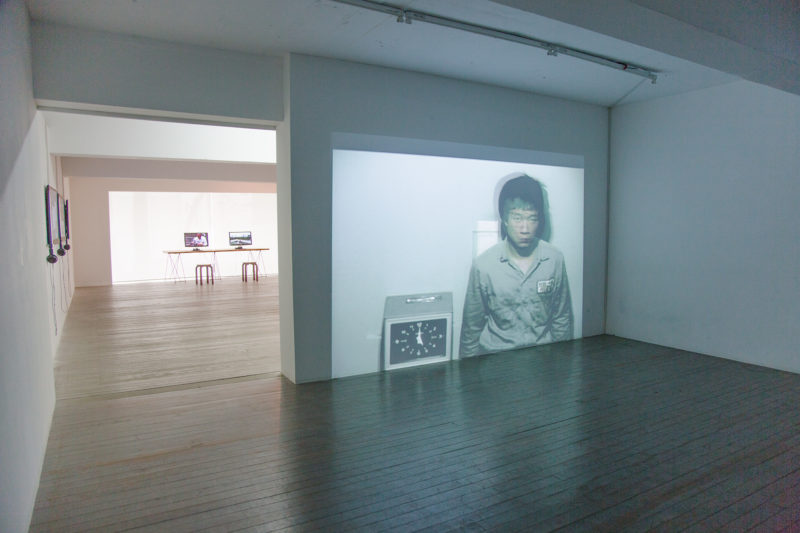
Utopian Days – Freedom was an exhibition at the Total Museum of Contemporary Art, Seoul, South Korea'south starting time private art museum. Afterward it was shown in the same city at the Nowon Culture and Arts Center.
Artists: Adel Abdessemed, Lida Abdul, Phil America, Ivan Argote, Chim↑Pom, Minerva Cuevas, Chto Delat?, Cyprien Gaillard, Yang-Ah Ham, Andre Hemer, Tehching Hsieh, Zhang Huan, Jani Leinonen, Klara Liden, Armando Lulaj, Matt McCormick, Filippo Minelli,
Wang Qingsong, Andres Serrano, Manit Sriwanichpoom,
Clemens von Wedemeyer, Kacey Wong, Xijing Men, He Yunchang.
For many, Hsieh is a cult figure. The rigor and dedication of his art inspire passion, while the elusive and epic nature of his performances generates speculation and mythology. Since April 11, 1980, Tehching Hsieh hasn't been able to sleep for a whole night without interruptions for twelve months. To be precise, he hasn't even been able to sleep for two hours running. Every 60 minutes, the sound betoken produced past his watch connected to a loudspeaker woke him upwardly and reminded him of the task he had self-imposed—that of clocking in at every single hour, 24 times a day, throughout a whole year.
Be it solar day or night, at every hr, Hsieh, wearing worker's uniform, went to a grey-walled room in his loft in Manhattan and stamped a time card in a sign-in motorcar. A few seconds later, a 16 mm camera captured a picture of his tense face next to the machine. A witness signed all the 366 time cards on the first day of the performance to assure that they couldn't be replaced. Moreover, at the stop of the twelve months, the witness confirmed that the xvi mm film was non falsified. Projected every bit a motion picture, it condenses a whole year into almost six minutes.
The creative person'southward hair, which is shaved at the outset of the film, reaches his shoulders at the finish of it. To consummate the moving-picture show, Hsieh had to undergo extreme psychophysical stress and reorganize his own life meticulously around the passing of the hours; for instance, he could non movement away from his loft for longer than 60 minutes.
Source: https://publicdelivery.org/tehching-hsieh/
0 Response to "Thirteen Year Piece Hsieh Will Make Art During This Time Will Not Show It Publicly"
Post a Comment