Review and Interpret Customer Functional Specifications and Drawings
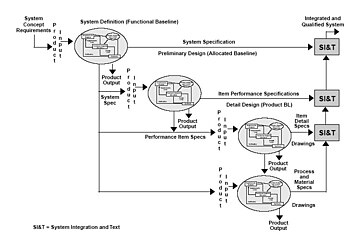
Systems engineering model of Specification and Levels of Development. During system evolution a series of specifications are generated to describe the system at different levels of particular. These plan unique specifications form the core of the configuration baselines. As shown here, in improver to referring to dissimilar levels within the system bureaucracy, these baselines are divers at dissimilar phases of the design process.Note: At that place is 1 minor (and ironic) typo in the image above. SI&T is "Arrangement Integration and Test" not "System Integration and Text".
A functional specification (besides, functional spec, specs, functional specifications certificate (FSD), functional requirements specification) in systems engineering science and software evolution is a document that specifies the functions that a organisation or component must perform (often function of a requirements specification) (ISO/IEC/IEEE 24765-2010).[1]
The documentation typically describes what is needed by the system user also as requested properties of inputs and outputs (e.g. of the software organization). A functional specification is the more technical response to a matching requirements certificate, e.k. the Product Requirements Document "PRD"[ commendation needed ]. Thus it picks up the results of the requirements assay stage. On more complex systems multiple levels of functional specifications will typically nest to each other, e.g. on the organization level, on the module level and on the level of technical details.
Overview [edit]
A functional specification does not define the inner workings of the proposed system; it does not include the specification of how the organization function will be implemented. Instead, it focuses on what diverse outside agents (people using the program, computer peripherals, or other computers, for case) might "observe" when interacting with the organisation.
A functional requirement in a functional specification might state as follows:
- When the user clicks the OK push, the dialog is closed and the focus is returned to the main window in the state it was in before this dialog was displayed.
Such a requirement describes an interaction between an external agent (the user) and the software organisation. When the user provides input to the system by clicking the OK button, the program responds (or should reply) by endmost the dialog window containing the OK button.
Functional specification topics [edit]
Purpose [edit]
In that location are many purposes for functional specifications. One of the chief purposes on team projects is to attain some course of team consensus on what the program is to accomplish before making the more than time-consuming endeavor of writing source code and test cases, followed past a menstruation of debugging. Typically, such consensus is reached after 1 or more reviews by the stakeholders on the project at hand after having negotiated a cost-effective fashion to achieve the requirements the software needs to fulfill.
- To permit the developers know what to build.
- To let the testers know what tests to run.
- To let stakeholders know what they are getting.
Procedure [edit]
In the ordered industrial software engineering life-cycle (waterfall model), functional specification describes what has to be implemented. The next, Systems compages certificate describes how the functions will be realized using a called software environment. In non industrial, prototypical systems development, functional specifications are typically written after or as part of requirements assay.
When the team agrees that functional specification consensus is reached, the functional spec is typically declared "consummate" or "signed off". Later this, typically the software development and testing squad write source code and examination cases using the functional specification equally the reference. While testing is performed, the behavior of the program is compared against the expected beliefs as divers in the functional specification.
Methods [edit]
Ane pop method of writing a functional specification document involves drawing or rendering either elementary wire frames or authentic, graphically designed UI screenshots. After this has been completed, and the screen examples are approved past all stakeholders, graphical elements can exist numbered and written instructions can exist added for each number on the screen example. For example, a login screen tin can have the username field labeled '1' and password field labeled '2,' and then each number can exist declared in writing, for use by software engineers and later for beta testing purposes to ensure that functionality is as intended. The benefit of this method is that countless additional details tin can exist attached to the screen examples.
Examples of functional specifications [edit]
- Advanced Microcontroller Bus Architecture
- Extensible Firmware Interface
- Multiboot Specification
- Real-time specification for Java
- Unmarried UNIX Specification
Types of software development specifications [edit]
- Fleck specification (disambiguation)
- Pattern specification
- Diagnostic blueprint specification
- Product pattern specification
- Software Requirements Specification
Encounter also [edit]
- Benchmarking
- Software development process
- Specification (technical standard)
- Verification and Validation (software)
References [edit]
- ^ ISO/IEC/IEEE 24765:2010 Systems and software engineering — Vocabulary
External links [edit]
- Painless Functional Specifications, 4-role series past Joel Spolsky
Source: https://en.wikipedia.org/wiki/Functional_specification
0 Response to "Review and Interpret Customer Functional Specifications and Drawings"
Post a Comment